Showing posts with label Growing Flowers. Show all posts

How to plant bulbs in fall

Autumn has arrived and that means it's time to put the bulbs in so next year's flowers will pop up in the spring! The first couple times I planted bulbs I did it all wrong! I planted them too shallow, I planted them too close together and I planted them at the wrong time of year.

Flowering Iris planted in fall, how to

I learned the hard way that if you plant them too shallow the chipmunks will dig them up and eat them. If you plant them too close together as certain bulbs multiply you're going to have to thin them out, and soon.

Also, if you plant them in the wrong season well you might not get anything for a year if at all.

So today I want to talk about what I've learned and put into practice since the first disastrous set of bulbs I planted.

How to: plant a butterfly garden

I don't know if you've heard, but the monarch butterfly is decreasing in population lately. They have declined by 85% in the last decade. Monarchs are different than other butterflies in that they only have one host plant for the caterpillars and it happens to grow in ditches in a long roadside so it's often treated as a weed and destroyed. 

butterfly on flower in butterfly garden

That plant is milkweed, more on that later.

However it's not just the monarchs! Over 450 butterfly species have declined in population since 1972! Butterflies are crucial pollinators (along with bees) for many produce crops.

No pollinators equals no food! We already know there's problems with the bee population and now... here we are with butterflies!

How to grow petunias from seed

Petunias are a garden staple, known for their colorful flowers and great for gardens or containers. They come in more colors and types than you could count! They do great in full sun but because they tolerate shade well they are often placed close to homes where they spent part of the day in the shadow of the house. 

Petunias growing from seed

I have been growing petunias for many years. I like using them in the garden but they're also great in planters. Since they spread out so well, they can be used as a pot filler.

Their colorful blooms attract lots of pollinators like butterflies and bees. Since your vegetables need pollinators, it's a good idea to welcome add to the garden!

How to grow marigolds from seed

Marigolds are a garden staple, known for their bright flowers and pest repelling qualities. They make excellent companion plants for tomatoes and are available in every garden nursery.

It's easy to grow marigolds from seed and they often come back every year, since they're pretty good at self seeding!

Marigolds growing from seed

I have been growing marigolds for many years. They are one of the flowers I wrote about in 8 flowers the you need in your garden. Many gardeners grow them for their color.

Their bright orange and yellow blooms attract lots of pollinators like butterflies. Since your vegetables need pollinators, it's a good idea to welcome them to the garden!

Many gardeners plant marigolds near tomatoes to repel nematodes and other pests on the nearby plants. Marigolds themselves get very few pests except for the occasional mite or aphid.

It's believed that the pungent scent of the marigolds discourages many pests from visiting the garden. 

They're said to deter both rabbits and deer, though unfortunately, they do nothing for chipmunks and other rodents.

Marigolds can grow thick enough to create a garden barrier, so if you need to keep rabbits out, plant them near any gaps in your fence line.

Marigold is the common name for over 50 species of flowering plants in the Tagetes family. They were native to the Americas, but have been naturalized throughout the world.

Various species are grown for their medicinal properties, culinary use, decoration and even pest repellant in the garden.

Seed packet & charm craft

The year the world shut down was one of the most challenging holidays that I have ever worked through. I drove myself half crazy coming up with gift ideas that don't use a ton of stuff you need to run out and buy!

I wrote about homemade gifts and many of them use ingredients you probably have on hand already. This week I'm going to try to do the same thing, but this one is a little homemade garden gift!

Homemade seed packets with butterfly and bee charms, craft

What I came up with next is a simple seed packet DIY. This will make a cute gift for a gardener friend. Plus it's a great way to share your favorite plants with friends!

All you'll need is a printer and you can make this using seeds you collected from your own flowering plants this year, or you can pick some seeds up at the local store.

I came up with 2 different seed packet designs. One features bees and the other butterflies, because pollinators are so important to our food supply!

I will also include a quick bracelet tutorial using charms I ordered at Michaels crafts. They offer curbside pick up, so I didn't even leave my car to get them back then, but that's still super convenient now!

How to grow African violets indoors

African Violets are one of my favorite houseplants to grow for one main reason, they bloom all year round! The second reasons that I love growing African Violets is that they are the simplest houseplant ever!

The only thing I don't like about them is that the leaves are fuzzy, which means cat hair seems to stick to them all the time!

White African violet flowering plant with purple tinged flowers

African violets are known for their beautiful flowers that bloom in many more colors than just violet! They can be found in every shade or purple, but also white, pink and even blue.

Anyone can grow these beautiful plants with just a few simple tricks. Lets talk about the ideal growing conditions to produce long lasting plants with a full head of flowers that bloom year round.

How to grow morning glories

When I was young, one of my favorite things about visiting my grandparents was the flowers that grew along the fence between their yard and the next. They had planted morning glories and brand new, beautiful, big flowers opened up every single morning. The vine grew so thickly that sometimes you couldn't see through the chain link fence at all! They were glorious!

Growing morning glories

It was one of the very first flowers I planted at my first house. I planted them by the fence exactly once and never had to plant them again! They came back on their own each year after that. At my current house I have them under the front porch so they grow up and across it. Each vine produces hundreds of flowers per season.

When do morning glories bloom?


Morning glories are a fast growing climbing vine with a literal ton of blooms that open super early in the morning and close around mid-day. You'll have to wake up before dawn to see the morning glory flowers opening!

Morning glory is the common name for over 1,000 species of flowering plants in the Convolvulaceae family. They were first grown in China for medicinal uses. The morning glory gets it's name because the flowers start to open before dawn.

These are not to be confused with the 4 O'clock flower who's flowers open around late afternoon each day, and the blooms close and die by morning. Or the Moonflower which doesn't even open till evening.

8 Flowers you need in your vegetable garden

Many people plant flowers in their vegetable garden. There are lots of reasons to do this from companion planting, attracting pollinators to them just being pretty! I've been doing it for as long as I've gardened.

Honestly, I never liked marigolds all that much, but my Pappap said you had to plant them in the garden so I have for the last 30 years. He was right!


Many gardeners find that they can discourage harmful pests, without losing the beneficial allies by just adding flowers. Flowers also add visual interest because vegetable plants are mostly green.

There is honestly not a lot of color in cucumber, bean, pea or broccoli plants! (just to name a few)

Planting flowers amid the tomatoes is a good way to dip your toes into the pool of companion planting.

Companion planting is placing different plants close together that enhance each other's growth, discourage pests and diseases, or have some other beneficial effect.

Companion planting can be an important part of an integrated pest management system.

Coleus, the most colorful houseplant.

Did you ever notice that most houseplants are just green? Sure some have flowers but most of them spend the vast majority of the time only green. It's kinda boring. Except for Coleus. Its pink, ruby, burgundy, yellow, white and green color variations are quite striking and can provide a pop of summer like color even in the dead of winter.

Coleus as a houseplant

Unfortunately, many gardeners don't realize that you can grow it as a houseplant! Coleus is actually a perennial. It's a tender perennial that is often used more like an annual, but in the right conditions it can grow year round.

Luckily, you have those conditions inside your house! Outside it's only hardy above zone 10. 

Coleus suffers cold damage at around 30°F, so if you have one growing outside you'll want to take cuttings or bring it inside before it gets too cold! It's super simple to grow more plants from cuttings, though...all you need is water.

How to grow amazing Hostas

I never really wanted to grow Hostas. I mean, they look nice and all but I just wasn't the greenery type. I preferred plants that were full of blooms, useful herbs or ones that produced vegetables. Shade gardening was never really my thing either, till we moved. When you live in the middle of the woods though you have a lot of shady areas to plant in and what better plants to take up space than a hosta?

Grow beautiful hostas

The hostas were already here when we got here though. There were two different varieties of hostas in the one garden bed. One was all green and the other was green and white. I learned pretty quickly that they were easy to care for and filled in large spaces well. 

That was enough to let them stay when I redid the flower beds and they have remained there for 10 more years.

I also learned that hostas (also known as plantain lilies) are really easy to divide, transplant and move around. They do not require a delicate hand when doing such things although they will recover more quickly if you're gentle! 

Forgetting them in a bucket for a week after digging them out of the garden might not be their favorite activity, but they will survive! Not that I know anything about that. lol

How to grow Sunflowers

Nothing says summer like the bright, sunny faces of a sunflower! They're just so cheerful. While a whole field of sunflowers are absolutely mesmerizing, they can be just as stunning when grown in smaller clumps or even alone.

I have been adding sunflowers to my landscaping and gardens for years. They are simple to grow and there are varieties that will fit almost any space.

Growing sunflowers, a tutorial

In fact they are one of the easiest to grow food crops. You can easily harvest the seeds for yourself, to share with your chickens or even the wild birds.

There are several types of sunflowers you can grow for seed or flowers.

I've grown everything from the black oil sunflower seeds that you commonly buy for bird seed and the common mammoth sunflower, to ornamental Teddy Bear sunflowers and a pretty Tigers Eye variety. 

The larger sunflowers obviously produce more sunflower seeds. They also produce larger seeds. Each sunflower head produces between 1000-2000 seeds!

Smaller ornamental varieties don't produce as many seeds but the seeds they do produce are still edible.

Many of the sunflower varieties have been developed more for the flower than the seeds, so you might have to try a few varieties and see what produces the most seed for the type you want to grow.

Unless you're only in it for the flowers...then absolutely choose by color, flower size etc.

Growing teddy bear sunflowers

Ornamental varieties are often small enough to fit into flower gardens or even containers. Which is great because no matter what the size of the garden spot you have you can find a sunflower to fit!

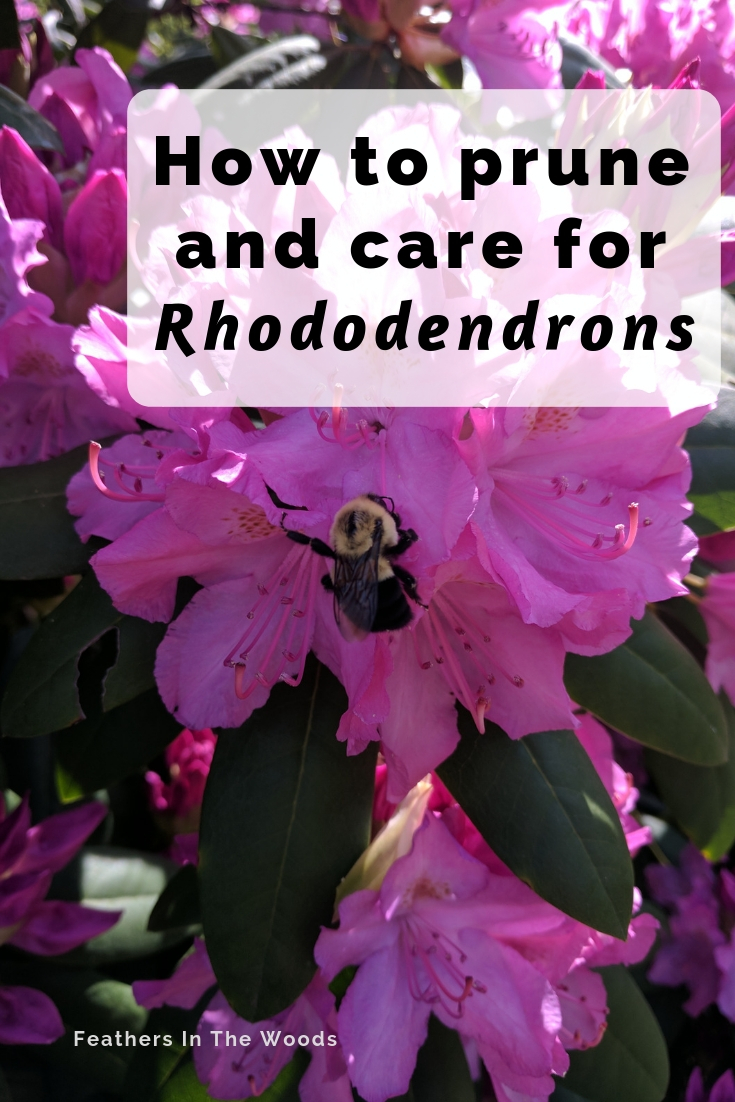
Caring for and pruning Rhododendrons

When we bought our house there were many perennial flowers and bushes planted throughout the backyard. One one side were 2 azalea bushes and on the other side was 1 rhododendron bush that has tripled in size over the last 10 years!

How to prune and care for rhododendrons

My husband hates that big thing! lol 

I love it though and it seems like the less I care for it the better it does. Pretty much the only thing I do to care for the rhododendron is to toss some bird seed under it every few days in the summer.

Ok, that sounded weirder than it actually is! I have chickens and the little ones like to go under the rhododendron bush. They hide from the adult chickens and the guinea fowl under there.

Of course while they're hanging out they poop from time to time which delivers a nitrogen rich fertilizer right above the roots. 

If I didn't have chickens adding fertilizer I would have to do it manually, but as it is chicken manure is great for fertilizing plants!

Thankfully chickens don't usually eat things that are bad for them which is a good thing since rhododendrons are poisonous to people and animals.

Obviously I didn't choose either plant but if I had I would have picked the rhododendron. I prefer it's flower clusters and size to the azaleas, they are mighty similar though and there's a good reason why.

How to grow Love Lies Bleeding Amaranth

I have been growing Amaranth for about 8 years now. I prefer Amaranthus caudatus the Love Lies Bleeding variety for it's long ropes of flowers and seeds. I first starting growing it as a feed source for the chickens, but I found it so beautiful and easy to grow that I have continued to grow it every year. It makes a striking centerpiece for my garden!

Growing love lies bleeding amaranth

The love lies bleeding variety of Amaranth is an annual that grows 3' - 4' in height. It is possible to grow as tall as 8', but I've personally never seen that. It's characterized by the long ropes of blood red flowers and red tinged stems with green leaves.

It grows easily from seed and prefers full sun.

Both the leaves and seeds of the Amaranth plant are edible.

I kind of hesitate to admit this but...I have never eaten the seeds or the leaves of the amaranth plants that I've grown. Crazy, I know since I am one of those 'eat the weeds' people.

Somehow this plant got pigeonholed in my garden as a animal feed plant and an ornamental. 

I promise I'll try it this year! Till then though...this is how I grow amaranth.

Growing 4 O'clock flowers

Have you ever heard of 4 o'clock flowers? A few years back I was struggling with growing moonflowers and decided to try growing 4 o'clocks instead. They grew perfectly and my love affair with the marbled, multi colored flowers was born!

The 4 O'clock flower, Mirabilis jalapa earned its name because the flowers open around late afternoon each day, and the blooms close and die come morning. Also called Marvel of Peru, these plants were originally cultivated by the Aztecs for medicinal and ornamental uses. 

Growing 4 O'clock, Marvel Of Peru flowers in your garden

One of the most unique aspects of this plant, is that different colored flowers can grow on the same plant! Flowers can be solid colored or have a combination of two colors in various patterns.

The plant can also change colors as it matures. You could plant a yellow flowered Marvel of Peru and months later it can start blooming pink.

While it's often assumed the flowers of the 4 O'clock open in response to daylight, they actually open in response to the daily drop in temperature that happens around 4pm each day.

How to force an Amaryllis to bloom again

If you're like me, everyone in your circle of friends and family knows you love plants. Which means you probably receive a lot of seasonal plants for gifts! Over the years I have gotten some of the most amazing poinsettias, paperwhites, evergreen bushes and even a rosemary topiary shaped like a Christmas tree!

A few years back my cousin gifted me with a beautiful red amaryllis. It bloomed right at Christmas time and had 2 flower stalks with 3 gorgeous blooms each. When she gave me the amaryllis (Amaryllis belladonna) she said something quite bizarre (at least to me).

How to force Amaryllis blooms

She told me "Sadly these are only good for one Christmas. Just like poinsettias." I told her not to worry, I'd figure out how to make it bloom again. After all, I turn my poinsettias red in time for Christmas every year. I figured out how to make my Christmas cactus bloom often. I can definitely figure this out!

A few weeks after the holidays were over, my plant drooped over and all the leaves dried up. I plucked them off but continued to water the bulb. Shortly after, it started to sprout again. The leaves grew just as tall and beautiful as before with one exception. No flower stalk. I had done some research though and knew this was normal. 

Grow amazing Lavender plants!

We all have that one herb we can't grow enough of and for me that herb is lavender. No matter how many lavender plants I have, I just can't get enough of these fragrant purple flowers!

Lavender growing in garden

I have been growing lavender for several years and by far my favorite variety is
English Lavender (Lavandula angustifolia) I love it so much that I even grow lavender right beside the kitchen door!

I use lavender in many different ways including lotions, salves, teas and even baked goods. I mostly use lavender for it's aromatherapy properties.

It's known to help induce sleep, calm anxiety, reduce stress and soothe headaches.

English lavender (also known as true lavender) is a small evergreen shrub and is the most aromatic variety of the lavenders. It is pest resistant and a low maintenance herb.

It's fairly easy to grow, but can be difficult to get started from seed. Many people choose to propagate lavender from cuttings instead as it is much easier.

How to grow lavender


How to design a flower planter you'll love!

We all know I love to garden but I noticed something about my gardening style a few years ago. I only plant flowers in planters! Weird, right? Unless it's an herb, all my flowering plants go in containers.

I do have a few rock gardens specifically for flowers but there are absolutely no ornamental flowers in my regular garden. 

planting flowers in containers

I'm also not picky about what kind of planters I use. I will plant flowers in any container that can hold dirt! I've used everything from a broken bucket to a kitty litter box for planters.

When choosing plants you want to consider their eventual size not the size at planting. Leave room for them to grow into their new habitat or they become root bound and their growth will be stunted.

Unfortunately that means the first few weeks after you plant your container can look rather sparse. When it fills in though, you'll be glad you left space!

Planting flowers in containers is really easy you'll just want to keep a few points in mind. 

How to create a magical fairy garden!

I love fairy gardens. I think they're super cute, plus the attention to detail just amazes me. I love all those tiny little benches, houses and signs. They are just so whimsical! I think my favorite thing about fairy gardens is that they can be anything you want. 

My new one is just a little forest scene but I've seen farm scenes, and garden scenes with little potting benches and greenhouses. I just picture the fairies playing in the gardens and planting flowers. I've seen a glamping scene and a tiny tea party. The fairy garden I made last year for my porch even had a water feature! 

Make a fairy garden

When I decided to put a fairy garden inside my house I knew exactly what I wanted and how I wanted it to look, but finding the pieces took a bit of time. I obviously needed fairy houses, signs and whimsical little statues but I also wanted a little 'stream' and a gold lined path. 

I decided I was going to need a fairly large container to fit all the things I wanted to. Luckily there are tons of planters available now, so I headed out to grab one and a few supplies to make this adorable fairy garden!

How to grow and harvest chamomile

To look at my garden you wouldn't know that I once had a hard time growing chamomile! I spent two years fighting to grow a few spindly little plants that only produced a few flowers each. It was so sad. Now my garden overflows with it every year. I was simply growing it wrong! I had no idea how to grow chamomile. Actually, I had no idea how to germinate chamomile. 

grow and harvest chamomile

The few plants that started I kept in pots on my patio because I was sure they'd die in the garden. *sigh* They really struggled in those pots.

Luckily I figured out the one trick to growing chamomile and now that I figured it out, I don't need it anymore! 

Because once you get a few chamomile plants growing well in your garden...they drop enough seeds every year to come back again, and again and again. You'll never have to plant chamomile again!

The two most popular types of chamomile are Roman Chamomile (Anthemis nobilis) and German Chamomile (Matricaria recutita). They have somewhat similar properties but I decided to grow German chamomile.

German chamomile is a taller annual plant versus the shorter perennial Roman chamomile. 

Normally I would say to plant the Roman variety and you'll never have to plant it again. The way the German chamomile self seeds though, makes that kind of a moot point!

I like to grow chamomile in the vegetable garden since it attracts ladybugs, any aphids that find my garden don't stand a chance!

How to succession plant a flower bed

I grow lilies. Lots of them! I have 8 different places where I have lilies planted. 3 of the flower beds are exclusive, meaning no other plant grows there perennially.

Two of my lily beds have other perennials in them and one has spaces for annuals. Some of the lilies I grow are quite beautiful but unfortunately when they die off for the year I'm left with scraggly empty looking beds. 

succession planting flowers

Same thing happens with the tulips.


Unfortunately this happens with lots of flowers, especially those grown from bulbs. Once they're done flowering they die off leaving the flower bed looking rather sad.

It can definitely be replanted, but unlike annuals that you can just rip out the whole thing, till and start again...you need to be careful not to damage the bulbs.

A few years back I came up with a plan to re-purpose those flower beds and have done it successfully for several years.

By succession planting the flower beds I can guarantee flowers for the whole growing season. It looks pretty and it's good for the soil to have different plants growing in it annually.

This year I started with the lilies by the driveway. I chose marigolds for the bees and I started them from seed, which is pretty easy. Had I used nursery starts I could have picked them up a few weeks ago. 

Many times I can find some great clearance buys this time of year and re-pot them to give them room to grow while I wait for the lilies to finish.  

I also had some Celosia that was growing in my carrots and I didn't plant them, so they needed moved. I'm guessing it was some sort of seed company accident.

Either way, I let them grow out knowing I'd be moving them when the time came.